ALL Electric
Should you buy one?
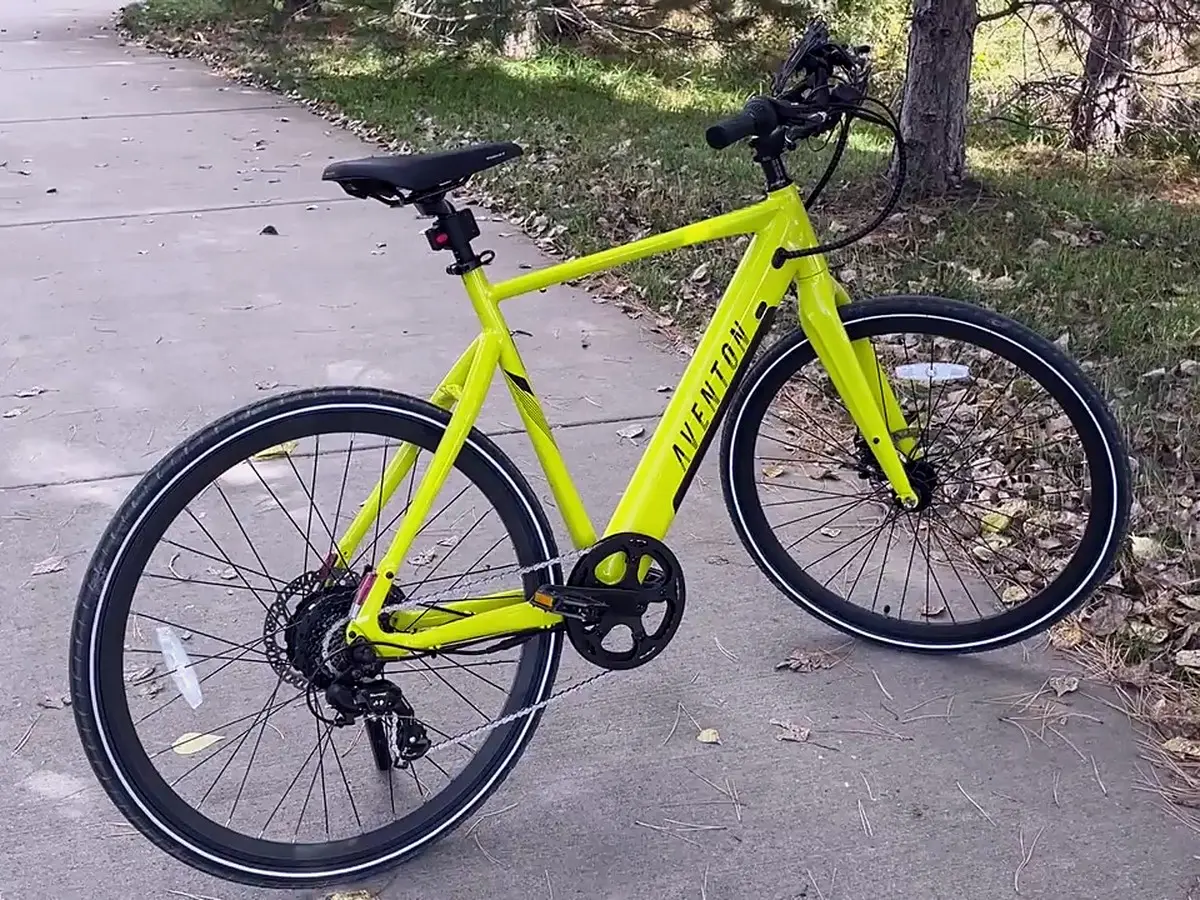
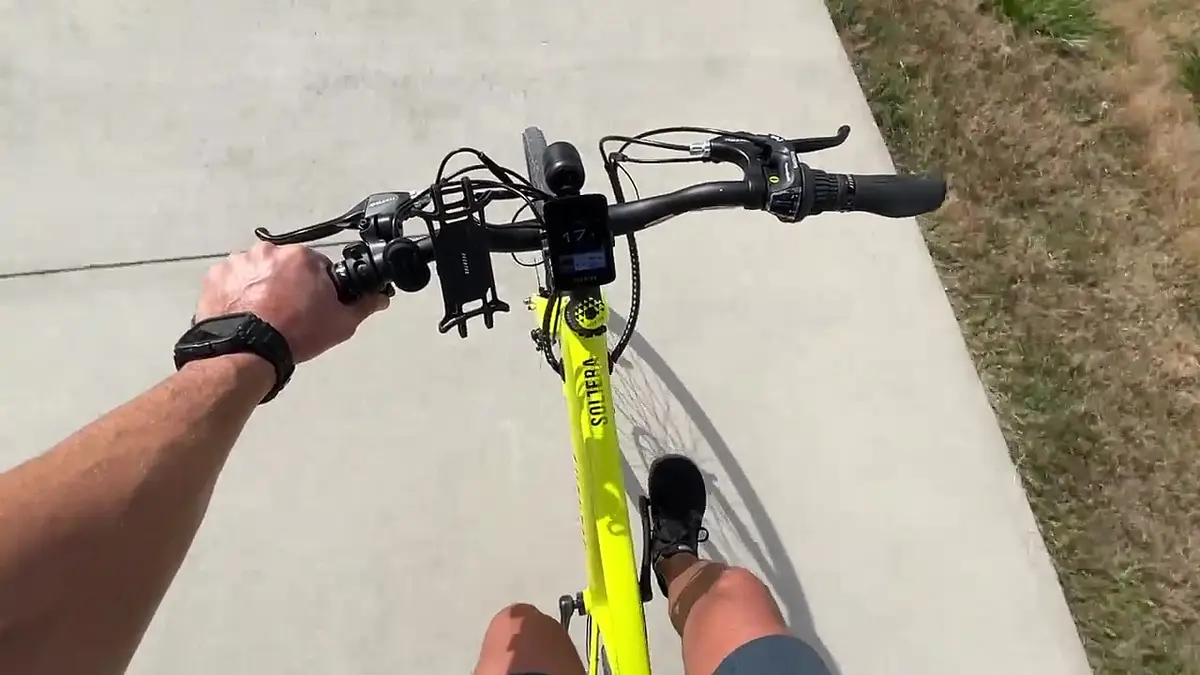
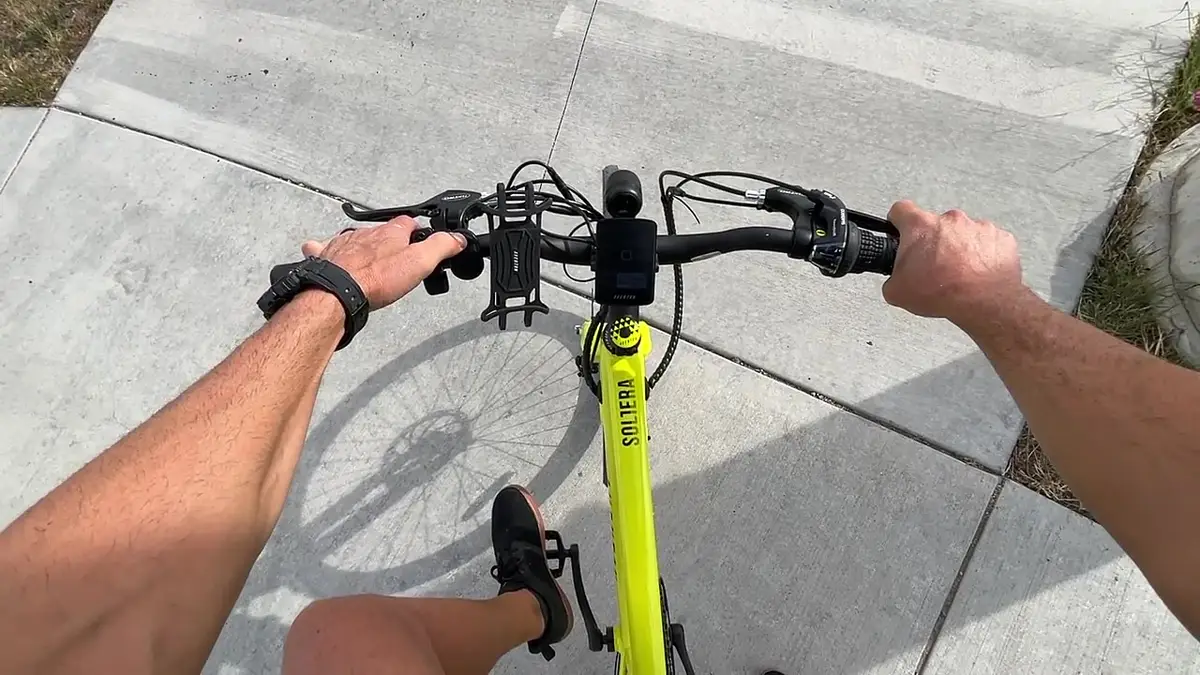
Buy the Soltera 2 if you want a light, low-key commuter for paved roads that you can carry up stairs. I rode it for several weeks. With the battery hidden in the frame, it doesn’t look like an e-bike, and its torque sensor makes the small motor feel stronger than its rating.
Skip it if your commute includes off-road trail. It has no suspension anywhere and handles gravel only okay. You should also skip it if you want hydraulic brakes or lots of throttle-only riding. The throttle works only while a pedal assist level is on.
The deciding factors: pavement or not, and whether you can find a Soltera 2 for less than the Soltera 2.5 that replaced it. As of Oct 22, 2026, Aventon’s Soltera 2 link goes to the Soltera 2.5, which lists at $1,199.
Who it’s for
- City and paved-path commuters. This bike was built for pavement.
- Riders who have to carry their bike. It’s light enough to take upstairs without hurting your back.
- People who don’t want their bike to look like an e-bike. The integrated battery hides it well.
- Riders who care about being seen. The bright yellow-green paint stands out in traffic.
Who should look elsewhere
- Anyone whose route includes off-road trail. There are no shocks, so choose a bike with a suspension fork.
- Big, tall riders. A viewer asked about riding it at 6’5” and 280 lb. I don’t have a published weight limit or size range for the Soltera 2, so check Aventon’s chart before you buy.
- Throttle-only riders. The throttle needs a pedal assist mode switched on, and riding on throttle alone cuts range hard.
Soltera 2 vs Soltera 2.5 vs Pace 500.3
| Soltera 2 (my test bike) | Soltera 2.5 (current) | Pace 500.3 | |
|---|---|---|---|
| Motor | 350W rear hub | 36V 350W, 540W peak, 45 Nm | 500W rear hub, 864W peak |
| Pedal sensor | Torque | Torque | Torque |
| Battery | 9.6Ah, integrated | 345.6Wh, integrated | 48V 12.8Ah (614Wh) |
| Rated range | Up to 46 mi | — | Up to 60 mi |
| Top speed | 20 mph | — | Throttle 20 mph |
| Brakes | Mechanical disc | Hydraulic disc | Hydraulic disc |
| Tires | All-terrain | Road | 27.5 x 2.1” |
| Gearing | 7-speed twist shifter | — | 8-speed thumb/index shifter |
| Weight | Light enough to carry upstairs | 46 lbs | 54 lbs |
| Price (as of Oct 22, 2026) | Replaced; link redirects to 2.5 | $1,199 | Discontinued (C$1,999 on Aventon Canada) |
A dash means I don’t have a sourced number for that cell. Soltera 2.5 figures come from Aventon’s current page, and its FAQ is where I found the Soltera 2’s mechanical brakes and all-terrain tires.
Soltera 2 vs 2.5: the 2.5 upgrades the mechanical discs I had to hydraulic brakes and switches to road tires. If you’re buying used, the 2 needs to cost clearly less than the 2.5’s $1,199 (as of Oct 22, 2026) to make sense, since the 2.5 has better brakes. If you ride some gravel, the 2’s all-terrain tires are the one thing it does better.
What the specs mean on the road
A 350W motor that doesn’t feel small
At 350W, the rear hub is smaller than most motors I test on this channel. Because the frame is light, I didn’t notice much difference. With some pedaling it got me up hills easily, but expect to do some of the work on climbs.
The torque sensor is the real upgrade
The Soltera 2 added a torque sensor, and Aventon has been moving its other models to torque sensors too. If you’ve only ridden cadence-sensor e-bikes, this is a big step up. The assist responds to how hard you’re pedaling, not just to whether the cranks are turning. Since you’ll pedal on hills anyway, that’s where you feel it most.
Range: 46 miles, under the right conditions
Aventon rates it for up to 46 miles. I expect that number comes from flat ground in Eco mode. If you ride in Turbo or use the throttle alone, the range will drop a lot. I didn’t run a measured range test on this bike. A few viewers asked what range they’d really get. It depends on how much you pedal.
No suspension
There are no shocks anywhere on this bike. It’s okay on light gravel and best on pavement. A viewer asked whether you can add a suspension fork. I haven’t tried, and I haven’t seen Aventon list one for this bike. If your commute includes off-road trail, choose a different bike.
Brakes and gears
The brakes are mechanical disc brakes, not hydraulic. That’s the clearest thing the 2.5 improves. Shifting uses a 7-speed twist shifter on the right grip.
Controls
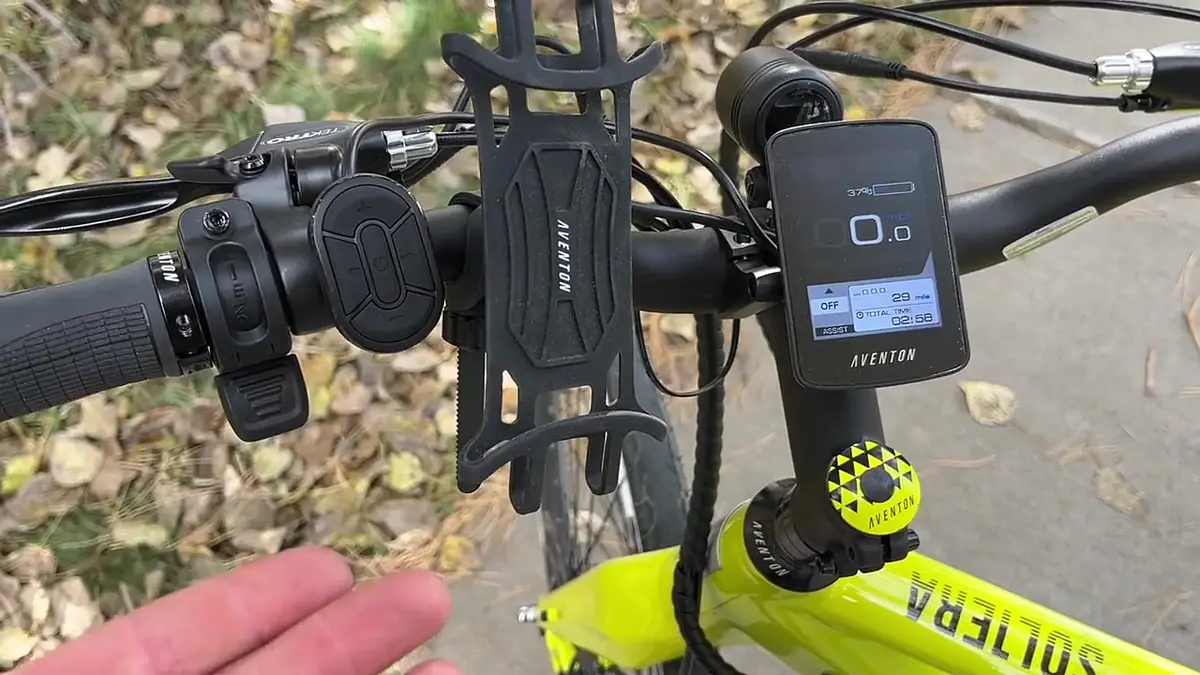
- Left grip: comfortable grips that flare out to support your palm, the front brake, an integrated bell (I believe the first Soltera had one too), and the throttle. The throttle works from zero, but only while a pedal assist mode is on.
- Control pad: power, plus + and – buttons to move through Eco, Tour, Sport and Turbo.
- Turn signals: they show a yellow light at the back. To me they feel a bit gimmicky, but they’re there if you want them.
- Display: a color display that pairs with Aventon’s app. The app is optional, which I like.
- Lights: hold + to turn on the headlight, and the display switches to night mode. Red lights on the back of the frame stay on steadily.
- Phone mount: the Aventon phone holder in my video is an extra accessory, sold separately. It works horizontally or vertically.
Comfort and looks
Aventon replaced the old branded seat with a cheaper one. It isn’t as cushy, but it was still fairly comfortable. The grips are comfortable, and the battery blends into the frame so cleanly that the bike doesn’t look like an e-bike. The yellow-green paint is bright and easy to spot.
Buying new instead: the Soltera 2.5
If you’d rather buy new, Aventon’s current Soltera 2.5 page lists a 36V 350W motor with 540W peak and 45 Nm of torque, a 345.6Wh battery, hydraulic brakes, road tires and a weight of 46 lbs. I haven’t ridden the 2.5. On paper it keeps the Soltera 2’s light, pavement-first design and fixes my brake complaint. It does give up the all-terrain tires, so the 2 is still the better pick for a little gravel.
Reliability
I’ve worked with Aventon for many years, and none of the bikes I’ve tested from them have given me problems. That record is a big part of why I recommend this bike over cheaper look-alikes online, along with the color display and the app.
Pros and cons
Pros
- Light enough to carry upstairs
- The torque sensor makes a 350W motor feel like enough
- Doesn’t look like an e-bike
- Comfortable palm-rest grips and an integrated bell
- The app is optional
- Bright, high-visibility paint
Cons
- No suspension; only okay on gravel
- Mechanical discs instead of hydraulic
- The throttle needs a pedal assist mode on
- The seat is a step down from the previous model
- Range falls in Turbo or on throttle only
FAQ
Would you still recommend the Soltera 2 in 2026? Only as a used bike at a real discount. Aventon now sells the Soltera 2.5 at $1,199 (as of Oct 22, 2026), and it adds hydraulic brakes.
Is it a good lightweight city e-bike? Yes. That’s what it does best. It’s paved-road-ready, light enough to carry upstairs, and doesn’t look like an e-bike.
Is it the best e-bike under $1,200? I can’t say that, because I haven’t tested every bike at that price. You can find cheaper bikes with similar specs online. With Aventon you get the color display, the app, and a brand that hasn’t given me any problems across the many bikes I’ve tested from them.
What real range do you get? Up to 46 miles is Aventon’s rating, which is most likely flat ground in Eco. Expect much less in Turbo or on throttle only.
How is it on gravel? It’s okay. There’s no suspension, so stick mostly to pavement.
Can I add a suspension fork? I haven’t tried it, and I don’t have an Aventon-listed fork upgrade for this model. If you want suspension, buy a bike that comes with it.
Can I ride it with throttle only? The throttle works from zero, but only with a pedal assist mode on.
Price
As of Oct 22, 2026, the Soltera 2 isn’t sold new on Aventon’s US site. Its link redirects to the Soltera 2.5 at $1,199. The price in my video didn’t come through clearly, so I’ve left it out.