 ALL Electric
Some links on this page are affiliate links. If you buy through them I may earn a commission at no extra cost to you. Read the disclosure.
Compare · Updated
Mokwheel Obsidian vs Aventon Aventure 3
I've reviewed both of these on my channel. The numbers below are from each brand's listing and my own testing; the takes are from my reviews. A dash means I couldn't verify that number yet.
Key differences
- The Mokwheel Obsidian lists for $199.01 less ($1,799.99 vs $1,999 in my review data).
- Motor: 1000 W on the Mokwheel Obsidian vs 750 W on the Aventon Aventure 3.
Mokwheel Obsidian
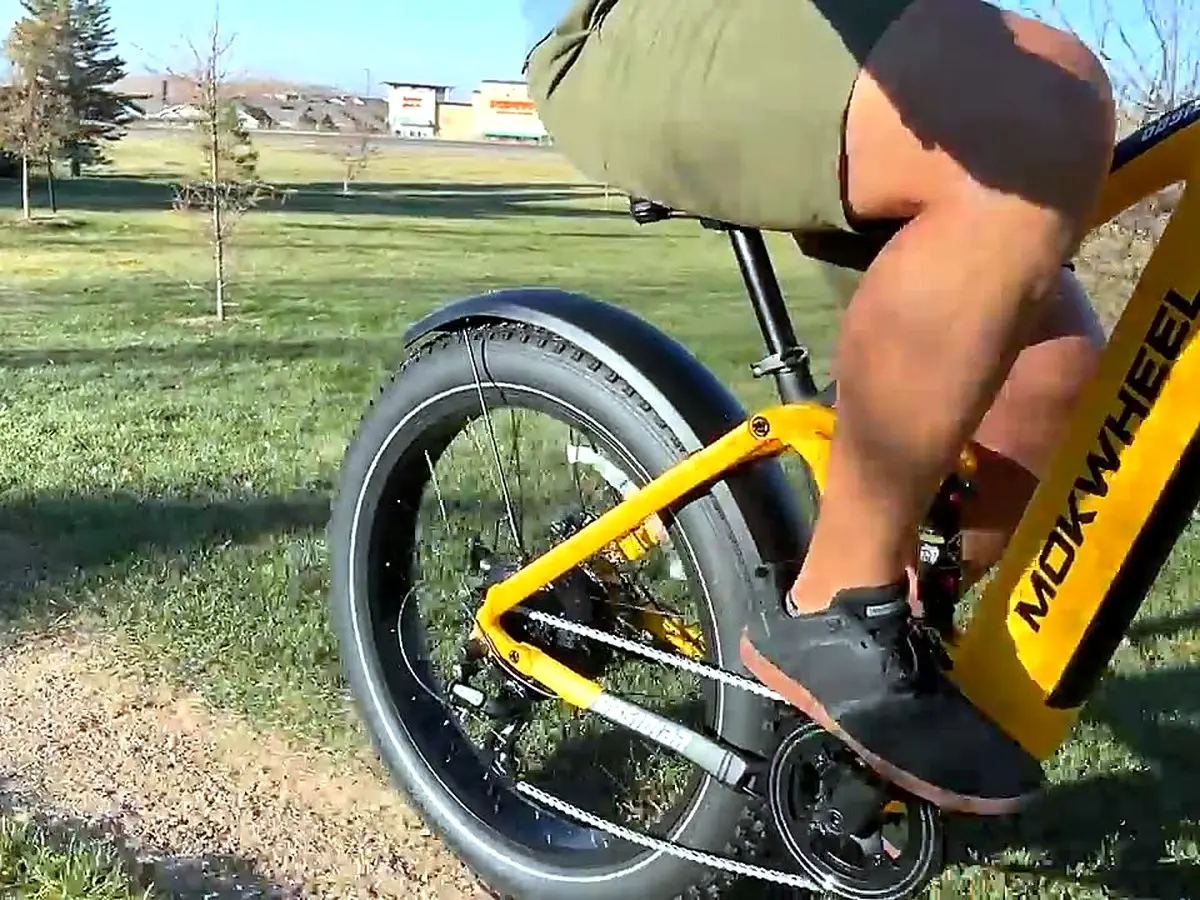
7.7AEB Scorehow it worksA full-suspension fat tire e-bike with a big 1000W hub motor and an optional inverter that turns the battery into a power station.
Aventon Aventure 3
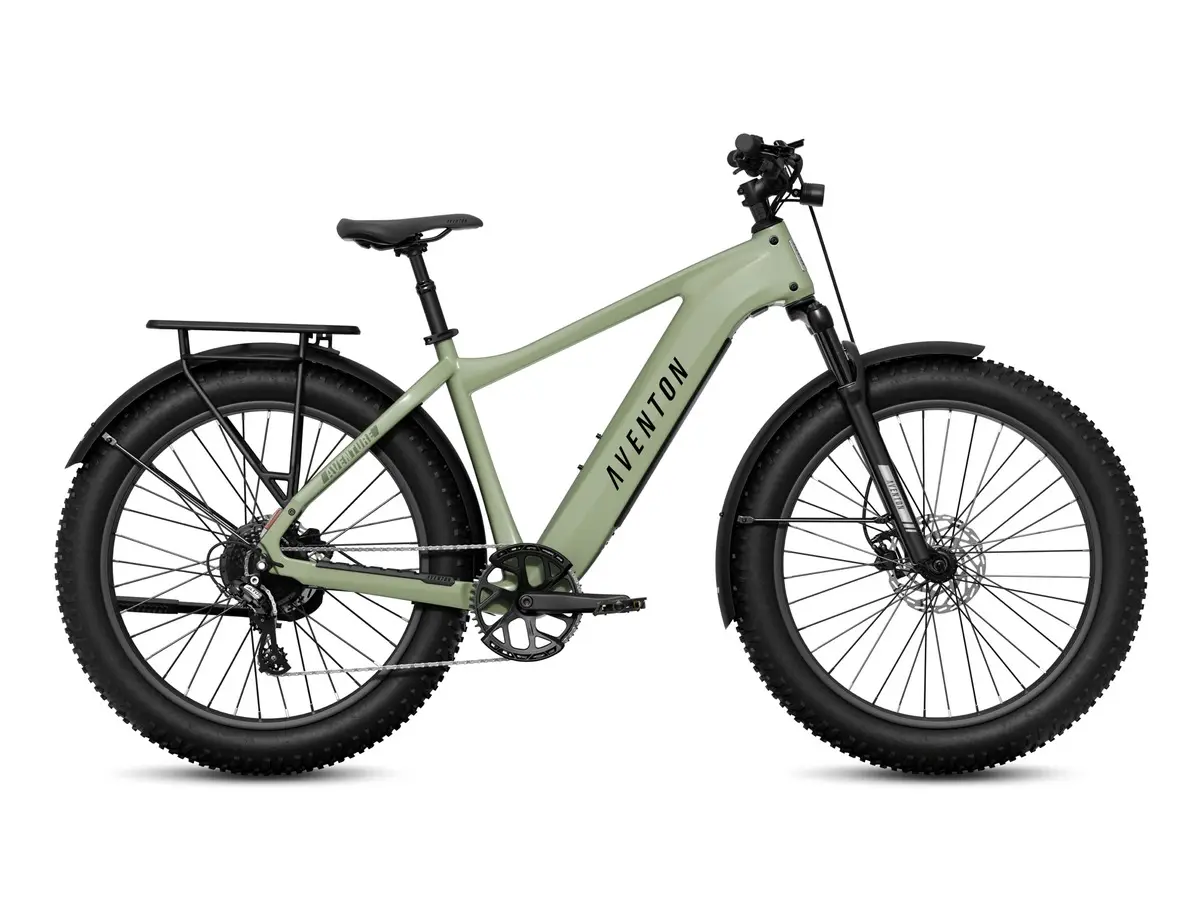
6.3AEB Scorehow it worksComfortable on gravel, lots of power, and the app lock is actually useful.
Some of these are affiliate links: I may earn a commission at no extra cost to you. Disclosure
Side by side
 |  | |
|---|---|---|
| Price | $1,799.99 | $1,999 |
| Type | Fat tire | Fat tire |
| Motor | 1000 W | 750 W |
| Battery | 941 Wh | — |
| Rated range | 80 mi | 65 mi |
| My tested range | — | — |
| Tires | Fat 4 in | Fat 4 in |
| Weight | About 77 lb (per Mokwheel) | 76 lb |
| Brakes | Tektro hydraulic disc | Hydraulic disc, front and rear |
| Max load | 560 lb | — |
| AEB Score | 7.7 | 6.3 |
| Buy | Check Mokwheel (code WILL30 = $30 off) | Check Aventon |
These two bikes land in the same search results and almost the same price bracket. The Mokwheel Obsidian is $1,799.99 on sale and the Aventon Aventure 3 is $1,999, both on the brands’ own sites as of Oct 26, 2026 (ET). Both are 26 x 4 in fat tire bikes with a rear hub motor, hydraulic brakes and a weight in the mid-70s.
Under that, they’re built around different ideas. The Obsidian is a full-suspension bike with more motor, more payload and a power inverter you can run a laptop off. The Aventure 3 is a hardtail with a suspension seatpost, integrated tail lights and an app with GPS location and a rear wheel lock.
One thing to know before you read on: these weren’t tested the same way. I put about 56 miles on the Aventure 3. My Obsidian video is an initial review, filmed the day I built it. I’ll flag the difference where it matters, and I won’t fill gaps with impressions I don’t have. Neither bike was range-tested.
I don’t have a side-by-side page for this pair on my compare page. There is an Obsidian vs Ramblas comparison there if you’re also looking at Aventon’s mid-drive.
The short answer
- Get the Obsidian if rear suspension matters to you, you’re a heavier rider or you carry a lot, or you want to power gear off the battery at a campsite. It’s also $199.99 cheaper right now.
- Get the Aventure 3 if you want the bike I’ve ridden the most of these two, built-in tail lights, an app with GPS location and a wheel lock, and the option to buy and service it through a bike shop.
Spec by spec
Brand numbers, checked Oct 26, 2026, unless marked “my video.”
| Mokwheel Obsidian | Aventon Aventure 3 | |
|---|---|---|
| Price (Oct 26, 2026) | $1,799.99 (sale from $2,199.99); Jungle Camo $1,899.99 | $1,999 |
| Motor | 750W rated, 1000W continuous, 1300W peak | 750W, 1440W peak in Boost |
| Torque | 105 Nm+ | 80 Nm |
| Sensor | Torque and cadence | Double-sided bottom bracket torque sensor; Sensor Switch lets you pick torque or cadence |
| Battery | 48V 19.6Ah, UL listed, IPX7 | 36V 20Ah, 733 Wh, UL 2271 |
| Claimed range | 60 to 80 mi | 65 mi |
| Class | Class 2/3: 20 mph throttle, 28 mph PAS | Class 2 |
| Suspension | 130 mm fork plus rear shock | 80 mm fork with lockout plus 50 mm suspension seatpost |
| Weight | 77 lb | 76 lb |
| Max load | 560 lb payload | 400 lb total |
| Brakes | Tektro TKD171 hydraulic | Tektro HD-E3520 hydraulic, 180 mm |
| Drivetrain | Shimano 8-speed | Shimano Altus 8-speed, 12-32T cassette, 48T chainring |
| Sizes | One size, 5’6” to 6’8” | Regular 5’3” to 5’10”, Large 5’10” to 6’4”; step-over or step-through |
| Charger | 48V 3A, time not listed | 42V 4A, about 5 h |
| Water rating | IPX6 whole bike | IPX5 |
| Warranty | 2 years | 2 years frame (lifetime if registered within 90 days), 2 years electrical |
| Returns | 15 days | 14 days, 1 mile or less for a full refund minus shipping |
A few rows deserve explanation.
Motor wattage. In my Obsidian review I called the Obsidian a 1000 watt rear hub (3:54). Mokwheel’s page now leads with “Rated Power: 750W,” and lists 1000W as continuous and 1300W as peak. Rated is what the motor is built to hold; peak is a short burst.
Weight. In my Aventure 3 review I called it a 75 lb bike (7:54). Aventon lists 76 lb. Call these two a tie on weight.
Sensor. Mokwheel lists a torque and cadence sensor, and in my Obsidian review I called the torque sensor a huge upgrade over cadence sensors (6:24 to 6:29). Aventon lists a double-sided bottom bracket torque sensor, and its Sensor Switch lets you choose torque or cadence feel.
Suspension: the biggest difference
The dual suspension is the reason the Obsidian exists. In my video I said that’s what makes it special, with the front fork and rear shock making it really comfortable to ride (3:45 to 3:52). Mokwheel lists a 130 mm fork. That comfort note comes from my first rides, not a long trail test.
The Aventure 3 has no rear suspension. Aventon includes a suspension seatpost, and that did more than I expected. On rougher terrain and trails, I said it provides so much cushion it’s almost like having a full-suspension e-bike (4:50 to 5:00). The fat tires helped too. They worked really well on gravel, which is what I mostly ride (4:33).
So here’s how I’d frame it. A suspension seatpost cushions you. Rear suspension also works on the rear wheel itself. If you ride rooty or rocky trails, the Obsidian’s setup looks better suited on paper, though I haven’t ridden it on that kind of trail. If you ride gravel roads and dirt paths like I did, the Aventure 3’s setup was plenty for me over 56 miles (2:05).
Power and speed
Obsidian. As delivered, it ships as Class 2, capped at 20 mph (3:54 to 4:00). In my video I said the motor gives you plenty of power on and off-road (4:03). I also noted that Mokwheel quotes a 28 mph top speed on pedal assist level five, while throttle-only stays limited to 20 mph (6:18 to 6:35). That’s why Mokwheel lists it as Class 2/3. The throttle won’t work in pedal assist zero, which I called a safety thing (3:00 to 3:05).
Aventure 3. The 750W motor provided a ton of power in my testing (6:39). The throttle works from zero (1:09). Aventon lists it as Class 2.
Where this leaves you: on paper the Obsidian has the stronger motor, 105 Nm against 80 Nm, and a higher pedal-assist ceiling. I didn’t run both bikes up the same hill, so I can’t give you a measured head-to-head.
Trail access. Some trails and paths allow only Class 1 or Class 2 bikes. The Aventure 3 is listed as Class 2. The Obsidian is listed as Class 2/3, so if you unlock 28 mph assist, it’s a Class 3 bike on those paths. Neither brand page I checked lists a Class 1 mode, so if your trails are Class 1 only, check with the brand first. My laws page and Class 2 vs Class 3 explain the rules.
Payload and hauling
This one isn’t close on paper. Mokwheel lists a 560 lb payload for the Obsidian. Aventon lists 400 lb total for the Aventure 3. I’m about 6’1” and 200 lb, so either bike covers me with room for gear. If you’re a heavier rider, or you plan to carry a lot on the rack, the extra 160 lb of rated capacity on the Obsidian is a real reason to pick it. For more on this, see my best e-bike for heavy riders guide.
The Obsidian’s inverter
This is something I hadn’t seen another e-bike company do. Mokwheel sells an inverter that lets you use the bike’s battery to power other electronics (7:30 to 7:41). I unboxed it in the video and tested it by charging one of the Toro batteries I use for my yard equipment. Once the inverter fan kicked on, it was pulling about 116 to 117 watts (10:38 to 10:47), and the blinking light showed the tool battery charging (10:52 to 10:55).
I can see that being useful for bikepacking: charge a laptop, camera gear or a phone, and plug into solar at camp (11:03 to 11:23). The fan is a little loud (11:31 to 11:34), though I think it’d be fine with the inverter on the ground and you at a table.
Mokwheel’s product page didn’t show me the inverter’s price, so confirm it before you count on it. Aventon doesn’t offer anything like it that I’ve seen.
Smart features, lights and security
This is where the Aventure 3 pulls ahead. It’s app connected (1:52 to 1:55). In the app you can see where your bike is (7:13), and you can set the bike to lock itself: a pin locks the rear wheel so it won’t spin, either every time you turn the bike off or at the press of a button (7:21 to 7:50). I actually used it. I rode to Trader Joe’s, hit lock in the app and ran in without locking the bike to anything (7:39 to 7:45).
The tail lights are integrated into the frame (4:18). There are turn signals too, which I find a bit gimmicky, and I wished I could turn both on as a hazard mode (1:27 to 1:37).
The Obsidian has a full-color display with a nice UI that shows your throttle use (3:07 to 3:20). It has a headlight button, but there’s no integrated tail light on this model (4:18 to 4:30). There’s a hidden horn under the controls (2:45). I didn’t cover an app in my video, and the Mokwheel specs I pulled don’t list one.
If you ride after dark, budget for a tail light on the Obsidian.
Comfort and fit
Obsidian. The grips are really comfortable, with a gel, almost Nike Air-bubble feel (2:26 to 2:31). The seat is rather wide but kind of rigid, though I said it’s plenty comfortable (4:08 to 4:15). It has my preferred kind of shifter, the thumb and index finger style (3:34), with one ring up front and eight gears in back (4:38). Mokwheel sells one size, listed for riders 5’6” to 6’8”.
Aventure 3. I said it fits me really well at about 6’1” and 200 lb (2:08 to 2:13). It also has the thumb-and-pointer shifter (2:24 to 2:27). I do wish Aventon had included the larger grips that come out under your palm (2:27 to 2:32). The chain guard covers only about half the chain (5:42 to 5:46), and the beefy slap guard took some hits on aggressive terrain (5:54 to 6:11). After some mud, the front splash guard let dirt and debris through (6:51 to 7:00). Aventon sells it in two sizes, Regular for 5’3” to 5’10” and Large for 5’10” to 6’4”, with step-over and step-through frames, so shorter riders have more options here.
Build and setup
My Obsidian arrived with plenty of spare parts, which I appreciated because I’ve had other bikes where a single missing screw stopped the build (0:58 to 1:06). One tip from my own mistake: the two fenders are different lengths, and the longer one goes on the back (1:11 to 1:19). The battery sits inside the frame and comes out with a key (4:55). Mokwheel’s FAQ says you install the front wheel, handlebars, pedals and a few other parts yourself, following its videos, or you can get help from its after-sales team or a dealer.
I didn’t film the Aventure 3 build in my review. If you buy it from a bike shop, the shop builds it.
Range, batteries, charging and weather
Neither bike was range-tested, so all I can give you is what each brand claims and what I saw on the display.
Obsidian. Mokwheel claims 60 to 80 miles from the Samsung 48V 19.6Ah battery. In my video I pointed out that many factors decide your real range, including your weight, whether you’re towing a trailer and the ambient temperature (5:44 to 5:58). Mokwheel lists the battery as UL listed and IPX7, and the whole bike as IPX6. It ships with a 48V 3A charger, and Mokwheel doesn’t list a charge time. The battery comes out with a key (4:55), so you can charge it indoors.
Aventure 3. Aventon claims 65 miles from a 733 Wh battery. The display shows range estimates and four modes: off, eco, sport and turbo (1:14 to 1:23). My 56 miles (2:05) is my total on the bike, not one charge. Aventon lists a 42V 4A charger at about 5 hours and an IPX5 rating.
On paper, the Obsidian has the bigger claim and the higher water rating. I’d treat both range claims as best-case numbers. If range is your top concern, my longest range e-bikes guide goes deeper on battery size and claims.
What I’d add on day one
- Obsidian: a tail light, since mine had no integrated one (Obsidian review, 4:28 to 4:30).
- Aventure 3: palm-rest style grips, which I wished it came with (Aventure 3 review, 2:27 to 2:32).
- Both: a good lock. The Aventure 3’s wheel lock stops the rear wheel from spinning, but it doesn’t attach the bike to anything (7:48 to 7:50).
Price and warranty
Mokwheel Obsidian: $1,799.99 on sale from $2,199.99, with the Jungle Camo color at $1,899.99 (mokwheel.com, Oct 26, 2026). When I filmed my Obsidian review, Mokwheel’s Black Friday price was $2,299 against a $2,899 regular price (12:05 to 12:19). Mokwheel lists a 2-year warranty and 15-day returns, and has a “Find A Dealer” page where US dealers offer test rides (mokwheel.com/products/obsidian, checked Oct 26, 2026). Check price at Mokwheel.
Aventon Aventure 3: $1,999 (aventon.com, Oct 26, 2026). Warranty: 2 years on the frame, extended to lifetime for the original owner if you register within 90 days; 2 years on drive, electrical and wheels; battery 2 years or 300 cycles; 1 year on everything else. Authorized Aventon Retailers handle warranty claims (aventon.com/pages/warranty, checked Oct 26, 2026). Returns: 14 days from delivery, full refund minus shipping if the bike has 1 mile or less, a 50% restocking fee if it’s used but under 20 miles, and you pay return shipping (Aventon terms, returns, checked Oct 26, 2026). The product page links to “Find a Bike Shop” for test rides and in-person buying. Check price at Aventon.
Elsewhere: 99 Spokes showed the Aventure 3 at $1,999 at Mike’s Bikes as well as Aventon (99 Spokes, checked Oct 26, 2026). I haven’t confirmed other retailers for the Obsidian.
Who should buy which
Pick the Obsidian if you:
- Want rear suspension for rough trails
- Weigh more or haul more, given the 560 lb listed payload
- Want the inverter for camping or bikepacking
- Are 5’10” or taller and fit its one size (5’6” to 6’8”)
- Want to save about $200 at today’s prices
Pick the Aventure 3 if you:
- Want the bike I’ve ridden more
- Ride mostly gravel and dirt roads, where the seatpost was enough for me
- Want integrated tail lights, app location and the rear wheel lock
- Are under 5’6”, or want a step-through frame
- Want to buy and service it through a local bike shop
Skip both if you:
- Need to lift the bike often or carry it up stairs; both are over 75 lb
- Need a Class 1 bike for your trails
- Mostly ride smooth pavement, where a lighter commuter is easier to live with. See my best e-bike under $1,500 picks.
The Aventure 3 was my top Aventon until I rode the Aventure M. In my Aventure M review I said I was switching to the M, mainly for the responsiveness of its mid-drive motor (7:20 to 7:40). If you’re open to a mid-drive, read Aventure 3 vs Aventure M. My best fat tire e-bike under $2,000 guide puts both of these bikes against six others.
FAQ
Is the Mokwheel Obsidian full suspension?
Yes. It has a front fork and a rear shock, and Mokwheel lists a 130 mm fork. I said the dual suspension is what makes it special in my Obsidian review (3:45 to 3:49).
Does the Aventure 3 have rear suspension?
No. It has an 80 mm fork and a suspension seatpost. On rough terrain the seatpost made it feel almost like full suspension to me in my Aventure 3 review (4:50 to 5:00).
Which is faster?
The Obsidian has a higher ceiling on paper: Mokwheel lists 28 mph on pedal assist and 20 mph on throttle, and it ships as Class 2. Aventon lists the Aventure 3 as Class 2. I didn’t time the two against each other.
Which goes farther on a charge?
Mokwheel claims 60 to 80 miles and Aventon claims 65 miles. My 56 miles on the Aventure 3 is total distance, not one charge.
Which is better for heavier riders?
On listed specs, the Obsidian, with a 560 lb payload against 400 lb for the Aventure 3.
Which fits shorter riders?
The Aventure 3. Its Regular size starts at 5’3”, and there’s a step-through version. The Obsidian comes in one size starting at 5’6”.
Did you test both bikes the same way?
No. I put about 56 miles on the Aventure 3. My Obsidian video is an initial review filmed the day I unboxed and built it, plus the inverter test.
Sources
- My Mokwheel Obsidian initial review: https://www.youtube.com/watch?v=lXs5Eza2WeI
- My Aventon Aventure 3 review: https://www.youtube.com/watch?v=ARP2kPH4J0k
- My Aventon Aventure M review: https://www.youtube.com/watch?v=38geGxb_5OM
- Mokwheel Obsidian product page and FAQ, https://www.mokwheel.com/products/obsidian, checked Oct 26, 2026.
- Aventon Aventure 3 product page, https://www.aventon.com/products/aventure-3-ebike, checked Oct 26, 2026.
- Aventon warranty, https://www.aventon.com/pages/warranty, checked Oct 26, 2026.
- Aventon returns, https://www.aventon.com/pages/terms-of-service#returns, checked Oct 26, 2026.
- 99 Spokes Aventure 3 listing, checked Oct 26, 2026.
What I said about the Mokwheel Obsidian
A full-suspension fat tire e-bike with a big 1000W hub motor and an optional inverter that turns the battery into a power station.
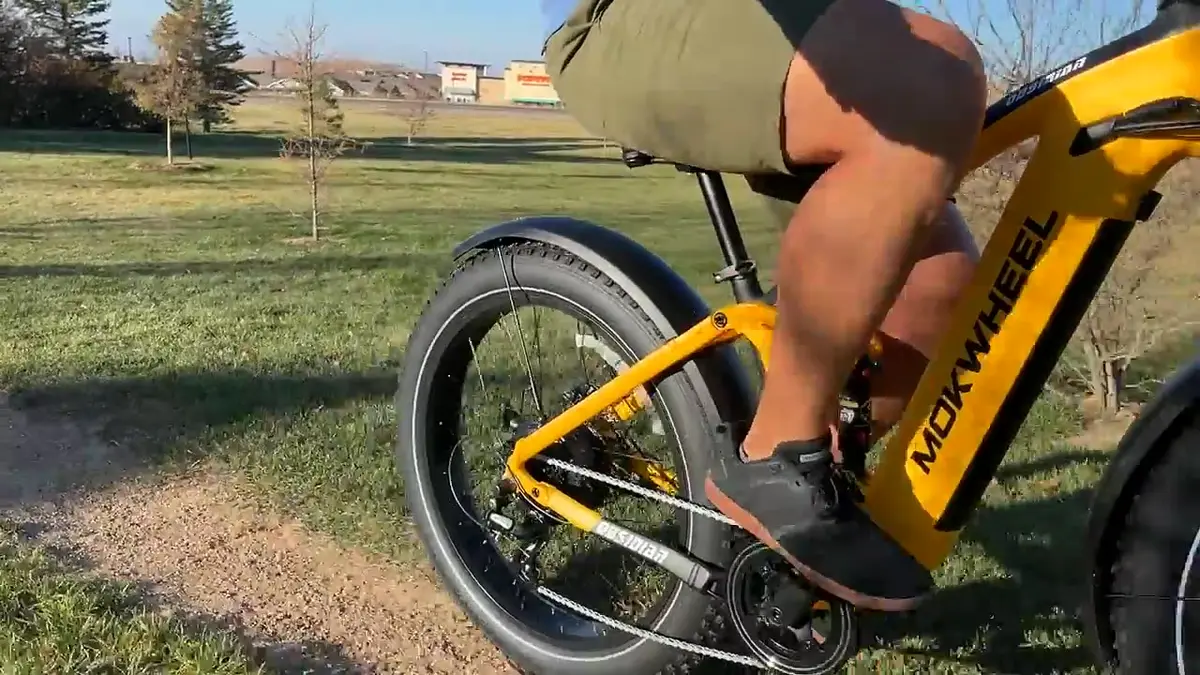
This is my initial review after unboxing and building the Obsidian. The dual suspension makes it really comfortable, the 1000W motor has plenty of power on and off road, and I love the styling, especially in yellow. The optional inverter is something I haven't seen from any other e-bike company: I charged one of my Toro yard tool batteries off the bike's battery, which makes this a fun pick for bike camping.
My video review, published
Liked
- Dual suspension makes it really comfortable
- 1000W motor gives plenty of power on and off road
- The shifter style I like best: thumb-and-index-finger, clean and easy
- Comfortable gel grips
- Mokwheel includes lots of spare bolts and screws
- Optional inverter ran a Toro battery charger at about 116 W off the bike
- Great looking, especially the yellow
Didn't
- No integrated tail light
- Display doesn't connect to your phone
- Throttle won't work in pedal assist 0 (a safety feature, but good to know)
- Inverter fan is a little loud
- Seat is wide but on the rigid side
What I said about the Aventon Aventure 3
Comfortable on gravel, lots of power, and the app lock is actually useful.
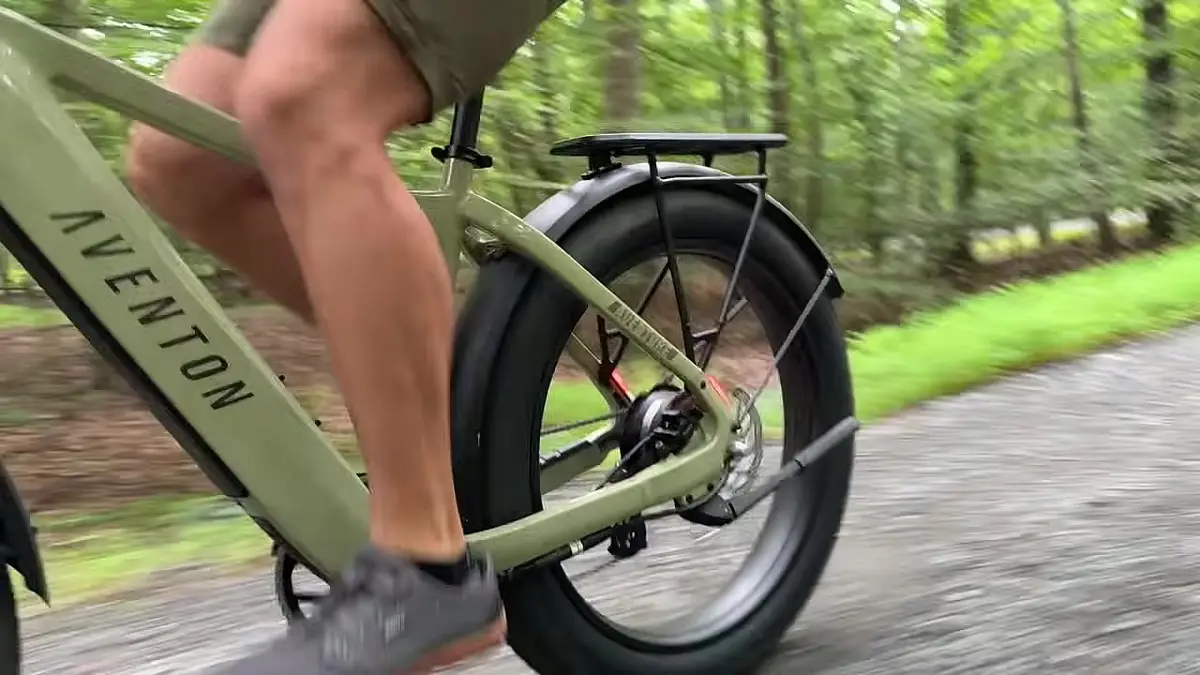
This is the best e-bike Aventon makes for me, and probably the best e-bike I've ridden, period. I'm 6'1" and about 200 lb and it fits me really well. I ride a lot of gravel now, and the fat tires plus the suspension seatpost make it feel almost like a full-suspension bike without the extra parts and cost. The 750W motor has plenty of power for any incline.
My video review, published
Liked
- Very comfortable on gravel and rough trails
- Suspension seatpost feels close to full suspension
- 750W motor with plenty of power on hills
- Beefy chain slap guard that held up to aggressive riding
- App-controlled rear wheel lock; I used it for a quick Trader Joe's run
- Fenders and rear rack included
Didn't
- Turn signals feel a bit gimmicky, and I couldn't find a hazard mode
- I'd like larger palm-rest grips (an easy swap)
- Front fender let some mud onto the underside of the battery
- Heavy at about 75 lb
Who should skip each one
- Mokwheel Obsidian: skip it if this is a dealbreaker: No integrated tail light
- Aventon Aventure 3: skip it if this is a dealbreaker: Turn signals feel a bit gimmicky, and I couldn't find a hazard mode
More: all comparisons · buying guides · how I test