 ALL Electric
Compare · Updated
Ride1Up Turris vs Ride1Up Prodigy V2 ECO
I've ridden the Ride1Up Turris on my channel. I haven't ridden the Ride1Up Prodigy V2 ECO, so its numbers below are from the brand's listing only.
Key differences
- The Ride1Up Prodigy V2 ECO lists for $100 less ($1,295 vs $1,395 listed prices).
- The Ride1Up Turris has the bigger battery: 672 Wh vs 504 Wh.
- Motor: 750 W on the Ride1Up Turris vs 250 W on the Ride1Up Prodigy V2 ECO.
Some links on this page are affiliate links. If you buy through them, I may earn a commission at no extra cost to you. Read the disclosure.
Ride1Up Turris
7.6AEB Scorehow it worksA simple, comfortable Class 3 commuter with a 750W motor, hydraulic brakes and fenders for well under $1,500.
Ride1Up Prodigy V2 ECO
Not ridden by WillA $1,295 Class 3 commuter with a Brose mid-drive (90 Nm), torque sensing, a 504 Wh battery, a rack and fenders.
Some of these are affiliate links: I may earn a commission at no extra cost to you. Disclosure
Side by side
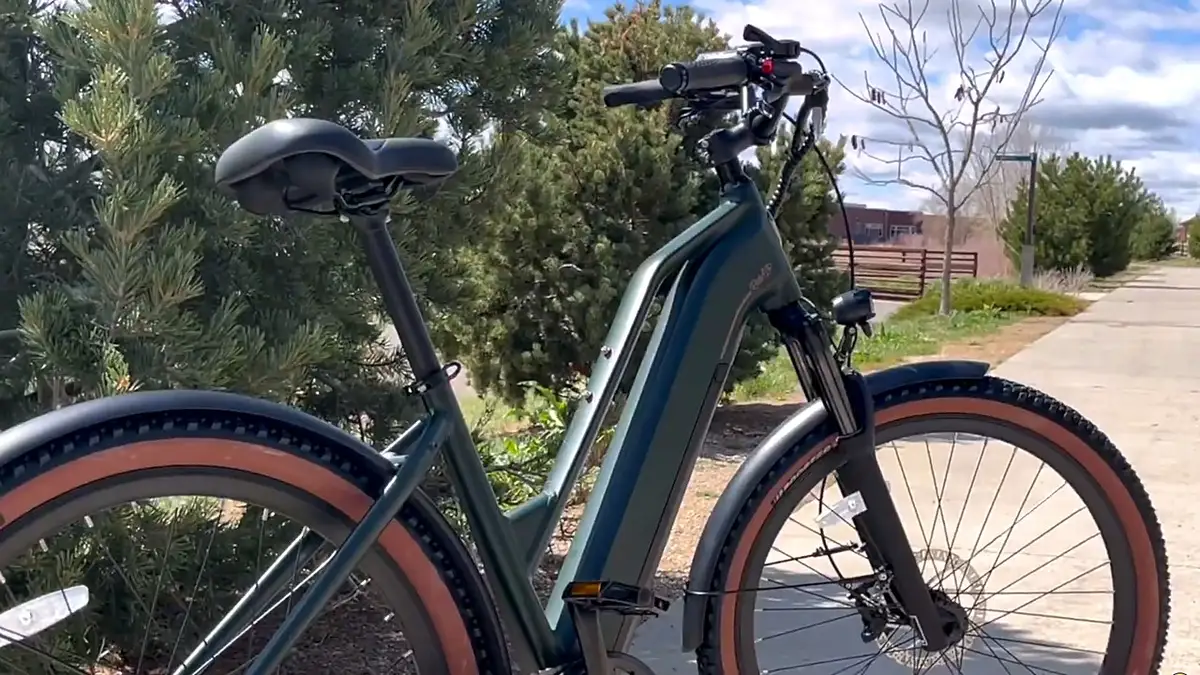 | 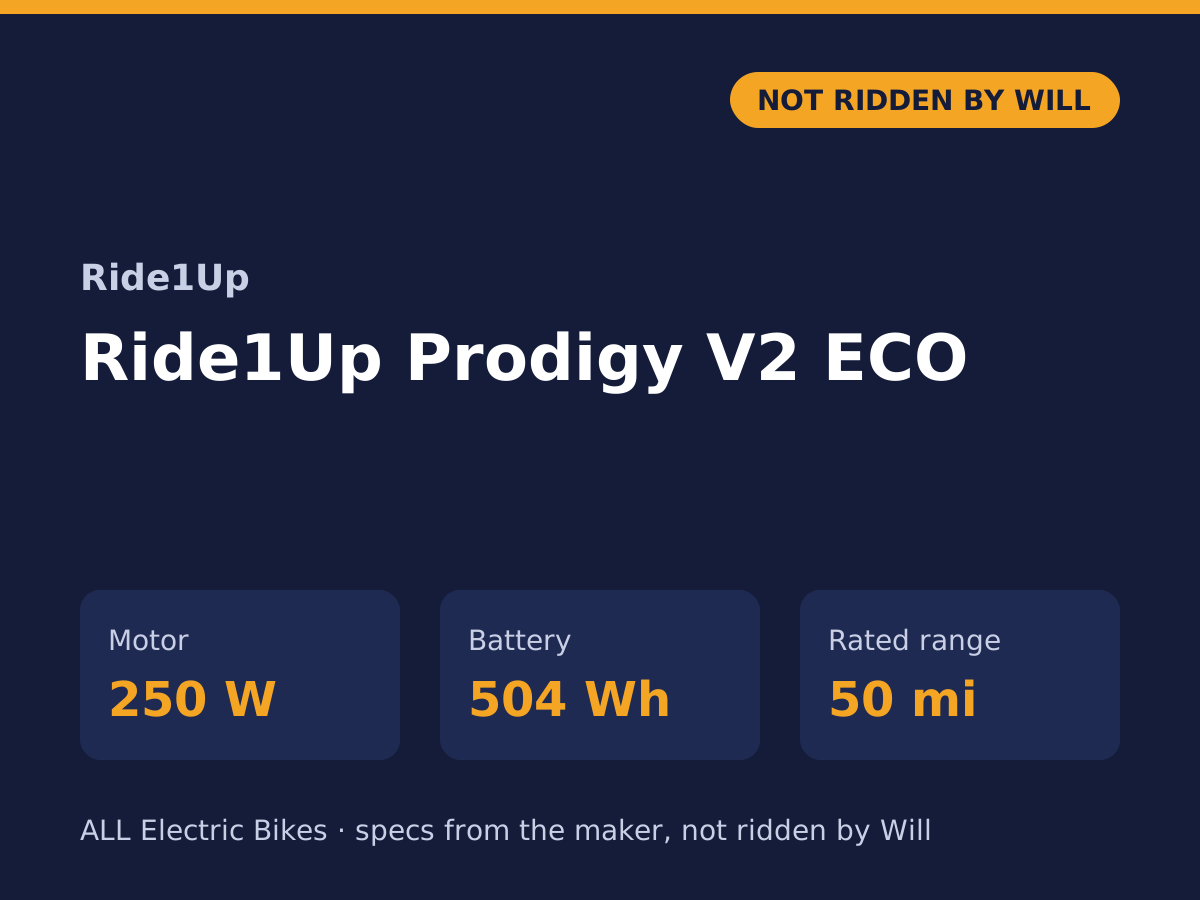 Ride1Up Prodigy V2 ECO | |
|---|---|---|
| Price | $1,395 | $1,295 |
| Type | Commuter | Commuter |
| Motor | 750 W | 250 W |
| Battery | 672 Wh | 504 Wh |
| Rated range | 50 mi | 50 mi |
| Tires | ||
| Weight | 54 lb (Ride1Up) | 58 lb |
| Brakes | Hydraulic disc, 180 mm | Hydraulic, 180mm rotors |
| Max load | 300 lb total | 300 lb |
| Buy | Check Ride1Up | Check Ride1Up |
Ride1Up sells two commuters $100 apart as of Oct 26, 2026 (ET): the Turris at $1,395 and the Prodigy V2 ECO at $1,295. Both use 27.5 in wheels and both are rated for 300 lb. They’re built around different drive systems. The Turris is a 750W rear-hub bike with a thumb throttle and a cadence-type sensor. The Prodigy V2 ECO is a 250W Brose mid-drive with a torque sensor and no throttle.
I rode the Turris. Ride1Up sent it to me for review (Turris video, 0:20 to 0:27). I haven’t ridden it, the Prodigy V2, so everything I say about that bike comes from Ride1Up’s current product page and manual, and I’ll say so when I’m reasoning rather than reporting. Both bikes are not range-tested by me, and I didn’t measure the Turris’s top speed, so the range and speed figures here are Ride1Up’s.
Quick answer
- Get the Turris if you want a throttle, want to ride without pedaling sometimes, or are taller than 6’1”.
- Get the Prodigy V2 ECO if you want a torque sensor and a mid-drive, don’t need a throttle, and are fine buying a bike I haven’t ridden.
Side by side
| Turris | Prodigy V2 ECO (I haven’t ridden it) | |
|---|---|---|
| Price, Oct 26, 2026 | $1,395, in stock | $1,295, in stock |
| Ships | In under 24 hours | In 3 to 5 business days |
| Motor | 750W sustained rear hub, 90 Nm (AKM angled gear) | Brose TF Sprinter mid-drive, 250W, 90 Nm |
| Sensor | R1CBC current-based cadence | Brose integrated torque sensor |
| Throttle | Left thumb throttle, 20 mph | None |
| Class | 2 or 3, 28 mph assist | 3, 28 mph assist |
| Battery | 48V 14Ah, LG cells, UL 2271, removable | 36V 14Ah Phylion, Samsung cells, 504Wh, removable |
| Charger | Not listed | 36V 2A, auto shut-off |
| Listed range | 30 to 50 mi | 30 to 50 mi |
| Gearing | Shimano 7-speed, Altus derailleur, 12-32T, 46T ring | MicroShift Advent 9-speed, 11-34T, 48T ring |
| Assist levels | Not listed | 4 |
| Display | KD21C, 2.2 in dual-tone LCD | Brose Allround, 1.5 in color |
| Brakes | LBN 180mm hydraulic, motor cutoff | 180mm hydraulic, brand not listed |
| Fork | 100mm, lockout | 100mm, lockout |
| Tires | Kenda K1227 27.5 x 2.4 | 27.5 x 2.10 (ST), WTB Ranger 27.5 x 2.25 (XR) |
| Lights | 60 lux front, rear brake light | 80 lux front, rack taillight |
| Rack | Sold separately | Included, 40 lb |
| Weight | 54 lb | 58 lb |
| Rider height | ST 5’1” to 6’2”, XR 5’6” to 6’4” | ST 5’0” to 6’0”, XR 5’5” to 6’1” |
| Max load | 300 lb | 300 lb |
Specs are from Ride1Up’s product pages, checked Oct 26, 2026, except the Prodigy’s removable battery, which comes from its manual (see Sources).
Two terms in that table. AKM is the motor maker Ride1Up names on the Turris page. R1CBC is Ride1Up’s name for its “Current-Based-Cadence System.” It’s a cadence-type sensor: it reads that the cranks are turning, not how hard you push. A torque sensor, like the Brose unit, measures your pedal force.
The Turris I rode vs the Turris now
The bike in my video isn’t quite the one Ride1Up sells today.
| Turris I rode (May 2023 video) | Turris now (Ride1Up, Oct 26, 2026) | |
|---|---|---|
| Price | $1,295 (0:33 to 0:37) | $1,395 |
| Battery | 48V 12.8Ah LG (1:29 to 1:35) | 48V 14Ah LG, UL 2271 |
| Listed range | 25 to 45 mi (1:29 to 1:35) | 30 to 50 mi |
| Class and speed | Class 3, 28 mph assist, 20 mph throttle (2:21 to 2:28) | Class 2 or 3, 28 mph assist, 20 mph throttle |
| Rear light | None, and I called that out (3:56 to 4:14) | Rear brake light |
| Fenders | Included (0:41 to 0:50) | Included |
| Tires | Gum sidewalls (3:13 to 3:16) | Kenda K1227 27.5 x 2.4 |
I haven’t ridden the current version, so the changes above are Ride1Up’s listing, not my experience.
Where the motor lives
The Turris puts the motor in the rear wheel. It pushes the bike when the sensor sees the cranks turning, or when you press the throttle. On my test bike the 750W motor gave excellent acceleration (0:59 to 1:06).
The Prodigy V2 puts the motor at the cranks. It drives the chain, so its power goes through the bike’s gears. Its torque sensor adds power in proportion to how hard you push. I haven’t ridden it, so I can’t tell you how that feels on this bike.
Why the 90 Nm figures don’t compare directly. Ride1Up lists 90 Nm for both motors. A hub motor’s torque is measured at the rear wheel. A mid-drive’s torque is measured at the cranks, and then the bike’s gears multiply or reduce it before it reaches the wheel. Same number, different measuring points, so don’t read the two figures as equal pulling power.
Day to day. With the Turris you can use the throttle and stop pedaling. With the Prodigy you have to pedal for any help at all. If you want the option of not pedaling, that decides it for the Turris.
Speed and class
How the class is set. My review bike came as a Class 3 e-bike with 28 mph pedal assist and a 20 mph throttle (2:21 to 2:28). Ride1Up’s current page calls the Turris “Class 2-3” and lists a “KD21C Adjustable Speed LCD,” but it doesn’t say which setting the bike ships in. Check the speed setting on the display when yours arrives. The Prodigy V2 ECO is listed as Class 3 with 28 mph pedal assist and no throttle.
Trail and path rules vary by state and by local agency, and class affects where you can ride. Check your state on /laws/ before you choose. My Class 2 vs Class 3 guide and e-bike classes explained cover the definitions, and California’s rules is one detailed example.
Range, battery and charging
Ride1Up lists both bikes at 30 to 50 miles. The batteries differ. The Turris’s 48V 14Ah pack works out to about 672Wh by my math (48 x 14). The Prodigy V2 ECO’s 36V 14Ah pack is listed at 504Wh. I haven’t tested either one, so I can’t say which goes farther. On my Turris, I said 25 miles was plenty for how I ride (2:02 to 2:09).
Removable batteries. The Turris page lists “two keys for the removable integrated battery system.” The Prodigy V2 manual describes removing the battery cover, then turning the key 90 degrees to unlatch the pack. So both can come inside for charging.
Chargers. Ride1Up lists a 36V 2A charger with auto shut-off and an LED status light for the Prodigy V2 ECO. The Turris page doesn’t list a charger spec. Neither page gives a charge time, so I’m not giving one.
The Turris pack is listed as UL 2271 certified. I didn’t find a UL listing on the Prodigy V2 ECO page, so I’m not claiming one either way. Charge on a hard surface, use the charger that came with the bike, and don’t leave a pack charging overnight unattended.
Gearing and hills
The Turris has a Shimano 7-speed SL-TX30 shifter, an Altus derailleur, a 12-32T cassette and a 46T chainring. The Prodigy has a MicroShift Advent 9-speed setup with an 11-34T cassette and a 48T ring. The Prodigy’s largest cog is bigger, which gives it a lower climbing gear. That’s a fact about the parts, not something I’ve felt.
I rode the Turris on asphalt, concrete and gravel (3:50 to 3:56). My video doesn’t include a measured climb, so I won’t give you a hill number for either bike.
Display, app and controls
Turris. Ride1Up lists a handlebar-mounted 2.2 in dual-tone LCD, the KD21C, with customizable pedal assist settings. The page doesn’t list how many assist levels there are, and it doesn’t list an app. The throttle is a left-side thumb throttle, run by a 48V 20A Lishui controller.
Prodigy V2 ECO. Ride1Up lists a 1.5 in Brose Allround color display with 4 pedal assist levels and no throttle. The page doesn’t list an app.
Brakes
Both bikes use 180mm hydraulic discs. The hydraulic brakes on my Turris gave reliable, responsive stopping (2:37 to 2:44). The current Turris lists LBN calipers with motor cutoff, so the motor stops pushing when you pull a lever. Ride1Up doesn’t name the Prodigy’s brake brand, and I haven’t used them, so I can’t compare stopping feel.
Maintenance and wear
Chain and cassette. A mid-drive sends its motor power through the chain, so the chain and cassette usually wear faster than on a hub bike, where the motor turns the wheel directly. The Prodigy uses a KMC chain with its MicroShift drivetrain.
Flats. Fixing a rear flat on a hub motor bike means dealing with the motor cable and a heavier wheel. A mid-drive’s rear wheel comes off more like a normal bike wheel.
Parts. On my Turris the tires and crank arms felt a bit cheap compared with higher-end models (2:47 to 2:51). The current Turris lists Kenda K1227 tires, and I haven’t ridden those.
Motor noise. I didn’t comment on motor noise in my Turris video, and neither product page gives a noise figure, so I can’t compare the two.
Theft and security
Both product pages describe the frame as having “internal protected & locked electronics.” Both batteries lock to the frame with a key (Turris page; Prodigy V2 manual). Neither page lists GPS tracking or an app lock. A keyed battery keeps someone from walking off with the pack. It doesn’t protect the bike, so budget for a real lock. Ride1Up sells a folding lock as an accessory.
Price, rack and kit
I reviewed the Turris when it was $1,295 (0:33 to 0:37). On Oct 26, 2026 it was $1,395. The Prodigy V2 went the other way. Electrek’s January 2024 review listed it at $2,395 for the chain version and $2,695 for the LX. Today the ECO is the only version Ride1Up sells, at $1,295.
The Prodigy’s price includes a 40 lb rack with a taillight, an 80 lux headlight, fenders and a phone mount. The Turris includes fenders, a 60 lux headlight and a rear brake light, and the rack is extra. I liked the Turris’s curved handlebar (1:16 to 1:19).
What happened to the Prodigy LX and CVT
When the Prodigy V2 launched, Ride1Up sold more than one version. Electrek’s review covered the chain version and the LX. OutdoorGearLab tested an LX XR CVT. On Oct 26, 2026, the old Prodigy V2 product URL redirected to the ECO page, and the ECO was the only Prodigy V2 version I found for sale. If you see an LX or CVT for sale, it’s old stock or used, and the specs on this page don’t apply to it.
Delivery and setup
Ride1Up says the Turris arrives 85% assembled, in a 53 x 10 x 27 in box that weighs about 70 lb. Plan on two people or a hand truck. Ride1Up said it ships within 24 hours on Oct 26, 2026. The Prodigy V2 ECO was listed as shipping in 3 to 5 business days, and Ride1Up posts a Prodigy V2 manual that covers assembly. Inspect either bike the day it arrives, because Ride1Up’s warranty asks for damage reports within 3 working days.
Fit, frame and storage
I’m 6’1” and about 200 lb, and the Turris was the perfect size for me (3:04 to 3:06). Ride1Up now lists the Turris ST for riders 5’1” to 6’2” and the XR for 5’6” to 6’4”.
The Prodigy V2 ECO runs a little smaller: ST for 5’0” to 6’0” and XR for 5’5” to 6’1”. At 6’1” I’d be at the top of the XR range. If you’re over 6’1”, the Turris XR is the one of these two listed for your height.
The Turris weighs 54 lb and the Prodigy 58 lb, with its rack. My Turris fit on my Steadyrack wall mount (3:18 to 3:23). I haven’t tried the Prodigy on one.
Warranty, returns and shipping
Both bikes have the same Ride1Up policies, checked Oct 26, 2026:
- Warranty: 1 year for the original owner (18 or older) in the contiguous US. Labor is covered for the first 30 days, then parts only. Shipping damage must be reported within 3 working days, and wear items aren’t covered. Ride1Up warranty
- Returns: 30 days, with under 20 miles on the odometer and no signs of use. You pay for return shipping. If you kept the original box, Ride1Up may send a prepaid label and deduct $250 to $350 from your refund, plus any damage or cleaning costs. Without the box, you arrange and pay for shipping yourself. Cancelling before the bike ships costs 3%, and cancelling after processing costs $250. The same page says Prodigy V2 clearance-sale orders are final sale with no returns. The ECO page didn’t call its price a clearance sale, but ask Ride1Up before you order if a return matters to you. Return policy
- Shipping: free to the contiguous US. Shipping
The CPSC lists no Ride1Up recall as of Oct 26, 2026.
Before you keep either one
The 30-day window is your test ride, but a return costs you $250 to $350 even if everything goes right. Ride your normal route before you pass 20 miles.
- Turris: check the class setting on the display, check that the throttle reaches 20 mph, and decide whether you’ll add a rack.
- Prodigy V2 ECO: ride your hardest hill in a low gear. At 6’0” or taller, check your reach and seat height on the XR.
Who shouldn’t buy the Turris
- Riders who want pedal-force sensing. The R1CBC sensor is cadence-based, not a torque sensor.
- Riders who want a rack included. It costs extra.
- Anyone who wants premium touch points. On my bike the tires and crank arms felt cheap (2:47 to 2:51).
Who shouldn’t buy the Prodigy V2 ECO
- Anyone who wants a throttle. It doesn’t have one.
- Riders over 6’1”. That’s the top of Ride1Up’s listed XR range.
- Anyone who wants a bike I’ve tested. I haven’t ridden this one, and the third-party test numbers I found were for the Prodigy V2 LX, not the ECO.
- Riders who hate drivetrain maintenance. Mid-drive power goes through the chain.
Who should look at the Velotric Discover 2
If you like the Turris idea, a 750W hub with a throttle, but want a torque sensor too, look at the Velotric Discover 2. I’ve ridden it. It has a 750W, 75 Nm hub motor and a torque sensor, and through the Velotric app you can make it feel like a cadence sensor instead. It also has turn signals. Velotric listed it at $1,499 as a sale price on Oct 26, 2026, and it weighs 63 lb to the Turris’s 54 lb. My full comparison is Velotric Discover 2 vs Ride1Up Turris.
Other reviews of the Prodigy
Every outside range test I found was of the Prodigy V2 LX, a different version with different parts and a higher launch price. For reference only, and not as ECO numbers:
| Reviewer (LX) | Lowest assist | Highest assist |
|---|---|---|
| Electric Bike Report | 65.3 mi (Tour) | 31 mi (Boost) |
| Electric Bike Review | 73 mi (Tour) | 32 mi (Boost) |
| OutdoorGearLab | Not reported | 19.34 mi (Boost) |
The spread between 19 and 73 miles shows how much assist level and test route matter. If you see a Prodigy range test online, check which version was tested.
Three riders, three picks
- A 10-mile commute with a hill, and you’d rather not arrive sweaty: the Turris. The throttle lets you take the hill without pedaling hard.
- A rider who wants a torque sensor and a mid-drive and doesn’t need a throttle: the Prodigy V2 ECO, knowing I haven’t ridden it.
- A 6’3” rider: the Turris XR, the only one of these two listed for that height.
FAQ
Is the Turris or the Prodigy V2 better for hills? I haven’t climbed on the Prodigy, so I can’t say from riding. The Turris has a throttle. The Prodigy has a lower climbing gear (11-34T vs 12-32T). Their 90 Nm ratings are measured in different places, so they don’t settle it.
Does the Prodigy V2 have a throttle? No. The ECO lists no throttle.
Which is faster? Both assist to 28 mph. Only the Turris adds a 20 mph throttle.
Which one is cheaper? On Oct 26, 2026, the Prodigy V2 ECO was $1,295 and the Turris was $1,395. The Prodigy’s price includes a rack.
Which one fits tall riders? The Turris XR is listed up to 6’4”. The Prodigy XR tops out at 6’1”.
Can I still buy a Prodigy V2 LX or CVT? Not from Ride1Up as of Oct 26, 2026. The old Prodigy V2 URL redirects to the ECO.
Did Ride1Up send you these bikes? Ride1Up sent me the Turris. I haven’t had a Prodigy V2.
Where to buy
- Turris: Ride1Up ($1,395, in stock Oct 26, 2026)
- Prodigy V2 ECO: Ride1Up ($1,295, in stock Oct 26, 2026). I haven’t ridden it.
Ride1Up is the only seller I verified for either bike. Both links are my affiliate links.
Related: Turris review, Prodigy V2 review, Velotric Discover 2 vs Ride1Up Turris, compare these bikes.
Sources
All checked Oct 26, 2026 (ET).
- Turris product page: https://ride1up.com/product/turris/ ($1,395, in stock, ships in under 24 hours, 85% assembled, box 53 x 10 x 27 in, about 70 lb; Class 2-3, 28 mph assist, 20 mph throttle; 750W, 90 Nm AKM; 48V 14Ah Reention LG, UL 2271; removable battery with two keys; 30 to 50 mi; KD21C adjustable speed LCD, 2.2 in dual-tone; R1CBC current-based cadence; 48V20A Lishui; Shimano 7-speed SL-TX30, Altus, 12-32T, 46T; LBN 180mm hydraulic with cutoff; 100mm lockout fork; Kenda K1227 27.5 x 2.4; 60 lux; rear brake light; fenders; internal protected and locked electronics; 54 lb; 300 lb; ST 5’1” to 6’2”, XR 5’6” to 6’4”)
- Prodigy V2 ECO product page: https://ride1up.com/product/prodigy-v2-eco/ ($1,295, in stock, ships in 3 to 5 business days; Brose TF Sprinter 250W, 90 Nm; torque sensor; 4 PAS; no throttle; Class 3, 28 mph; 36V 14Ah Phylion, Samsung, 504Wh; 30 to 50 mi; 36V 2A charger with auto shut-off; 180mm hydraulic; 100mm lockout; MicroShift Advent 9-speed, 11-34T, 48T, KMC; 27.5 x 2.10 / WTB Ranger 27.5 x 2.25; Brose Allround 1.5 in color display; 80 lux; 40 lb rack; fenders; phone mount; internal protected and locked electronics; 58 lb; 300 lb; ST 5’0” to 6’0”, XR 5’5” to 6’1”). https://ride1up.com/product/prodigy-v2/ redirected here.
- Prodigy V2 manual (battery removal, page 13): https://ride1up.com/wp-content/uploads/2023/09/ProdigyV2-Manual-9.21.23.pdf
- Ride1Up warranty: https://ride1up.com/warranty-info/
- Ride1Up return and pre-order policy (30 days, under 20 miles, buyer pays return shipping, $250 to $350 label deduction, 3% and $250 cancellation fees, Prodigy V2 clearance final sale): https://ride1up.com/return-and-pre-order-policy/
- Ride1Up shipping: https://ride1up.com/shipping/
- CPSC recalls: https://www.cpsc.gov/Recalls
- Electrek Prodigy V2 review (Jan 19, 2024; launch prices): https://electrek.co/2024/01/19/ride1up-prodigy-v2-review-an-affordable-brose-mid-drive-e-bike-for-the-common-man/
- Third-party Prodigy V2 LX range tests (not used for ECO figures): https://electricbikereport.com/ride1up-prodigy-v2-lx-review/ , https://electricbikereview.com/ride1up/prodigy-v2-review/ , https://www.outdoorgearlab.com/reviews/biking/electric-bike/ride1up-prodigy-v2-lx-xr-cvt
- Velotric Discover 2 page: https://www.velotricbike.com/products/velotric-discover-2 ($1,499 sale price; 750W, 75 Nm; 63 lb)
- Video: Ride1Up Turris review (May 21, 2023)
What I said about the Ride1Up Turris
A simple, comfortable Class 3 commuter with a 750W motor, hydraulic brakes and fenders for well under $1,500.
I rode the Turris for several weeks and called it a fantastic e-bike that offers exceptional value at its price. The 750W motor accelerates well, the hydraulic brakes are reliable, and the fenders and upright position make it an easy commuter. Some parts, like the tires and crank arms, felt a bit cheap, and my test bike had no rear tail light (Ride1Up now lists one).
My video review, published
Liked
- Exceptional value; it was $1,295 when I tested it
- 750W motor with excellent acceleration
- Class 3: 28 mph pedal assist, 20 mph throttle
- Reliable, responsive hydraulic disc brakes
- Front and rear fenders included
- Comfortable, upright position from the curved handlebar
- Fit me well at 6’1” and 200 lbs
- Looks great, with gum sidewall tires
- Handled asphalt, concrete and gravel
Didn't
- Tires and crank arms felt a bit cheap
- No rear tail light on my test bike; Ride1Up now lists one
- Rear rack costs extra
- Cadence-based assist, no torque sensor
The Ride1Up Prodigy V2 ECO (not ridden by me)
A $1,295 Class 3 commuter with a Brose mid-drive (90 Nm), torque sensing, a 504 Wh battery, a rack and fenders.
On paper the Prodigy V2 ECO is Ride1Up's budget mid-drive commuter. For $1,295 (as of Oct 26, 2026) Ride1Up lists a Brose TF Sprinter mid-drive (250W, 90 Nm) with a torque sensor and 4 assist levels, a 36V 14Ah (504 Wh) battery, 180mm hydraulic brakes, a 100mm fork with lockout and a 9-speed drivetrain. It's Class 3 with pedal assist to 28 mph and no throttle, and it weighs 58 lb. A 40 lb rear rack, fenders and lights come standard. I haven't ridden it.
Strengths on paper
Watch-outs on paper
Who should skip each one
- Ride1Up Turris: skip it if this is a dealbreaker: Tires and crank arms felt a bit cheap
More: all comparisons · buying guides · how I test